





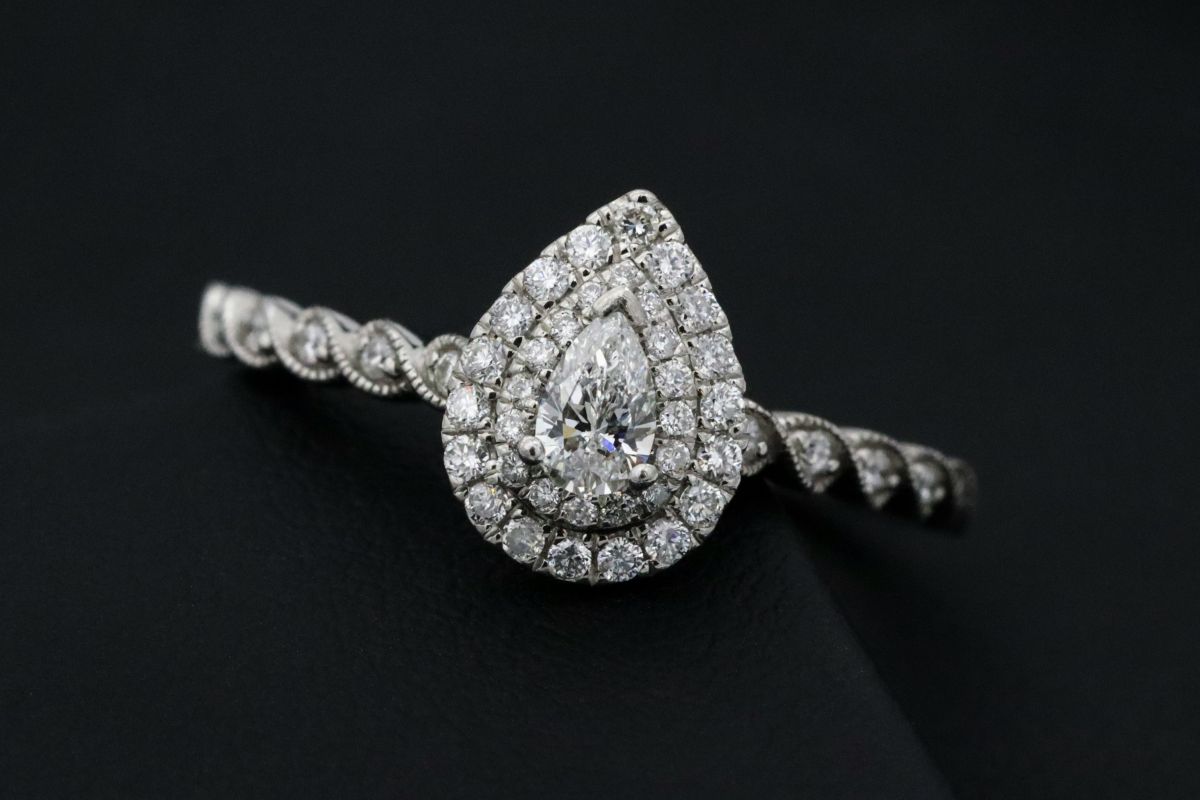
The Diamond engagement ring feels like one of those traditions that has always existed, as permanent and unchanging as the stone at its center. But the real story of how Diamond jewelry became the enduring symbol of love may surprise you.
The tradition of wearing rings is both older and more modern than you might think, with roots stretching back to ancient Rome and an enduring reputation that owes a remarkable debt to a single advertising slogan from 1947.
From iron bands and royal betrothals to South African mines and Madison Avenue copywriters, here is how the Diamond engagement ring became the symbol it is today.
Rings as Symbols of Commitment Long Before Diamonds Entered the Picture
Long before a Diamond ever graced a betrothal ring, the ring itself carried all the meaning. The earliest concrete evidence for formal betrothal rings comes from ancient Rome, where a ring represented a couple's legal agreement to marry.
Roman betrothal rings were made of iron, chosen for strength and durability rather than beauty. The ring itself was the statement. It signaled permanence, a binding of two parties, and the material mattered precisely because it did not break or bend. The circle, with no beginning and no end, served as a natural symbol of eternity, which is why it became the form through which so much human devotion has been expressed ever since.
The First Diamond Engagement Ring on Record
The moment Diamonds entered the betrothal picture is well documented. In 1477, Archduke Maximilian of Austria ordered a Diamond ring for Mary of Burgundy, marking the first recorded instance of a Diamond being used in a betrothal ring. Maximilian had small Diamonds set in the shape of an "M" in a gold band.
It was a striking gesture, but not one that was accessible for ordinary people for a very long time. For the four centuries that followed, Diamond engagement rings remained almost entirely within reach of European royalty and the highest levels of nobility only. There was no cultural expectation that a Diamond belonged in a proposal for anyone outside those circles.
How Victorian Romanticism Transformed Engagement Ring Culture
A shift began in the 19th century, driven by two forces that arrived roughly at the same time.
Queen Victoria reigned for more than six decades, and the jewelry she wore, widely featured in newspapers, was copied across Britain and beyond. Her taste in Diamonds and her very public romantic life with Prince Albert helped fuel the idea that Diamond jewelry was a fitting expression of love.
In the late 1860s, significant Diamond deposits were found in South Africa. According to the Gemological Institute of America, this made the dream of owning a Diamond engagement ring attainable for the emerging middle class for the first time. Supply expanded, prices fell, and a stone once reserved for aristocracy began appearing on the hands of merchants and professionals.
Victorian ring design evolved alongside this shift. Nature-inspired settings became fashionable, with flowers, leaves, and serpents worked into the metalwork. An engagement ring in this era was no longer simply a marker of financial standing. It was expected to express emotional depth.
The Campaign That Made the Diamond Engagement Ring a Universal Expectation
The biggest turning point in the history of the Diamond engagement ring can be traced to a Philadelphia advertising agency.
In 1947, copywriter Frances Gerety was finishing a late-night session at N.W. Ayer & Son, the agency hired by De Beers to revive sagging Diamond sales. She penned four words: "A Diamond is Forever."
The campaign that followed is now widely regarded as one of the most influential marketing initiatives in advertising history.
Before the De Beers campaign, engagement rings featured a wide variety of gems, with no single standard. What De Beers did was reframe the Diamond entirely, not as a luxury purchase, but as a universal expression of lasting love. N.W. Ayer described its goal as making the engagement ring "a psychological necessity" that could top any other purchase a couple might consider. By the 1990s, over 80 percent of engagement rings featured Diamonds.
What the Diamond Engagement Ring Means Today
More than a century after the Victorian era and nearly eight decades after the De Beers campaign, the Diamond engagement ring remains central to how people mark a commitment. What has changed is how couples personally interpret the tradition.
Modern shoppers choose cuts, settings, metals, and stones that reflect their own story, from classic solitaires to vintage-inspired halos to bold, colored Diamond accents. That adaptability contributes to the enduring appeal of the tradition.
The human instinct is to mark a lasting commitment with something equally lasting. For those beginning the search for an engagement ring, Colonial Jewelers' guide to Diamond shopping is a good place to build a foundation.
Begin Your Own Chapter at Colonial Jewelers in Frederick
Every couple who chooses a Diamond engagement ring is joining a tradition that spans thousands of years.
For over 77 years, Colonial Jewelers has helped couples in Frederick, Maryland, do exactly that. Our Gemologists certified by the Gemological Institute of America hand-select every Diamond in our collection, and we offer the kind of honest, unhurried consultation this decision deserves. We back our engagement rings with a lifetime warranty, because a ring that represents forever should be cared for that way.
Visit us in our Frederick showroom, reach out online, or give us a call at (301) 663-9252. We would love to help you find the Diamond engagement ring that tells your story.