





Engagement rings convey enormous meaning in a small package, a circle of metal and stone that marks one of life’s biggest moments. But the styles we recognize today did not spring up overnight. They evolved with history, culture, and shifting tastes, era by era.
From the sentimental details of the Victorian period to the crisp geometry of Art Deco to the personalized styles of today, the engagement ring has always been a reflection of its time. Here is a look at how engagement ring styles have changed throughout the decades, and what that history means for couples choosing a ring now.
Victorian Era (1837–1901): Rich in Symbolism
Queen Victoria’s reign gave us some of the most emotionally layered jewelry ever made. Victorian engagement rings were full of meaning.
Serpents (symbolizing eternity), flowers, hearts, and acrostic gem settings spelling words like “Dearest” were all beloved motifs. Yellow gold was the dominant metal, and old-mine-cut Diamonds gave rings a warm, distinctive glow.
When Diamonds were found in South Africa during the latter half of the 19th century, the gems became more accessible to the growing middle class.
Edwardian Era (1901–1915): Lace in Metal
Around the time King Edward VII ascended to the throne, ring designs softened into something more airy and more refined. The introduction of workable platinum allowed jewelers to create delicate filigree and intricate milgrain detailing that mimicked fine lace. Old European-cut Diamonds, flowing floral motifs, and a distinctly feminine quality defined the era.
This period is sometimes called the “garland era” for its love of trailing flower and leaf designs. These intricate, romantic rings remain among the most sought-after vintage styles today.
Art Deco Era (1920s–1930s): Geometry Takes Over
Few periods in jewelry history are as instantly recognizable as Art Deco. Born out of the cultural energy of the Jazz Age following World War I, Art Deco engagement rings traded floral softness for bold geometry, sharp lines, and striking color contrast.
Platinum continued to be the preferred metal, and Diamonds were frequently combined with sapphires, emeralds, rubies, or onyx. This style was named after the Exposition Internationale des Arts Décoratifs et Industriels Modernes held in Paris in 1925.
Art Deco rings remain among the most celebrated vintage styles for their confident, architectural beauty.
Mid-Century (1940s–1960s): The Diamond Solitaire Reigns
The mid-20th century brought a defining shift. In 1947, copywriter Frances Gerety wrote “A Diamond is Forever” for De Beers, a line that Ad Age later named the greatest advertising slogan of the 20th century. This campaign fundamentally changed how Americans viewed the Diamond as the anchor of an engagement ring.
Styles of the era matched postwar optimism, and clean, refined solitaires became the standard, with the round brilliant cut Diamond as the defining choice. The ring was built to let the Diamond speak.
1970s and 1980s: Bigger and Bolder
By the 1970s, couples were pushing back against minimalism. The princess-cut Diamond was introduced in this decade and became one of the most popular Diamond shapes worldwide.
Larger stones, yellow gold settings, and sculptural band designs reflected an appetite for self-expression. The 1980s leaned into glamour, with marquise and oval cuts gaining ground alongside colored Diamond accents and Hollywood’s growing influence on bridal jewelry.
1990s to 2000s: Personal Above All
This era marked a turn toward genuine personalization. Couples sought rings that felt individual. Creative settings, mixed metals, colored gemstone center stones, and unconventional band styles all gained traction. The engagement ring became less about convention and more about identity.
Today: Vintage Inspiration Meets Contemporary Taste
What Is Trending Now
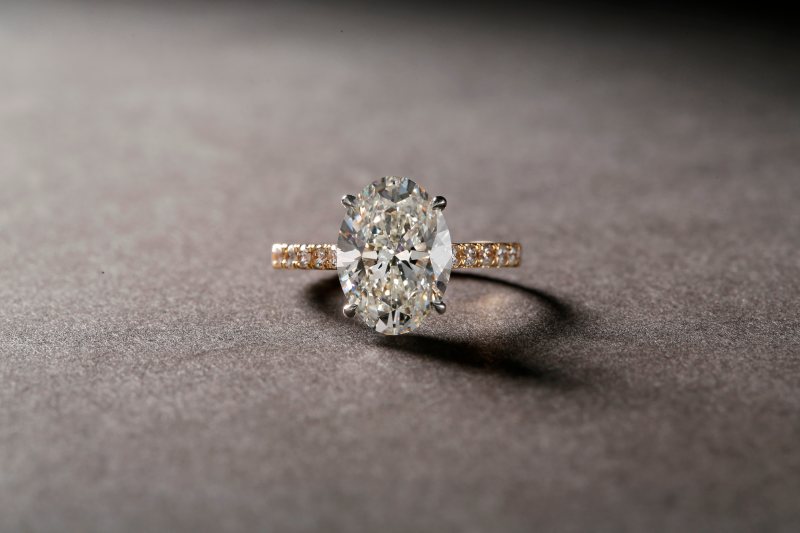
Today’s engagement ring market pulls freely from every era. Halo settings, characterized by a circle of smaller Diamonds encircling the central stone, have consistently enjoyed popularity, providing extra brilliance that is reminiscent of Victorian and Edwardian cluster designs. Cushion cut and oval Diamonds are among today’s most in-demand shapes, while Art Deco-inspired toi et moi rings have made a notable comeback.
Clean solitaires and bezel-set Diamonds remain perennial favorites, a look rooted in mid-century simplicity that has never gone out of fashion.
While both lab-grown and natural Diamonds are available today, natural Diamonds carry something lab-grown stones cannot replicate: millions of years formed beneath the earth. For those who value rarity, heritage, and authenticity, a natural Diamond remains the timeless choice.
Because ring prices at many retailers shift seasonally, it is worth seeking out a jeweler with consistent, year-round pricing. The engagement ring collection at Colonial Jewelers offers that kind of reliable, steady pricing all year long.
Find Your Ring at Colonial Jewelers: Frederick, Maryland’s Trusted Jeweler
Whether your heart is set on Edwardian filigree, Art Deco geometry, or a sleek modern solitaire, Colonial Jewelers is here to help you find it. Serving Frederick and the surrounding community for over 77 years, our Graduate Gemologists hand-select every Diamond we carry, and our in-house master jeweler can bring a custom design to life from the ground up.
Every genuine Diamond engagement ring we sell is backed by a free lifetime warranty, a rare commitment that protects your investment for as long as you wear it.
Visit our showroom in downtown Frederick, call (301) 663-9252, or book an appointment online. Your ring is waiting.